

Transforming our food system to safeguard the interests of current and future generations is impossible without embracing the circular economy. Livestock farming plays a key role in this, as repeatedly emphasised by individual players in this field.
Efficiency: The Cornerstone of Sustainable Livestock Production
Let’s reflect: Massive productivity gains in agriculture during the past century enabled population growth that has now brought us to the brink of planetary boundaries. Livestock contributes significantly to meeting the nutritional needs of a growing global population through a process known as upcycling—the conversion of plant biomass into highly digestible food for humans. Animal-based foods generally offer superior nutrient density & bioavailability compared to plant-based alternatives, with notable advantages in essential amino acid profiles and vitamins (e.g., B vitamins).
From 1950 to today, livestock production has focused on efficiency improvements, drastically reducing resource consumption per unit of animal-based food. For example, feed efficiency has markedly increased, meaning less feed is required to produce meat, milk, or eggs. These advancements have bolstered food security and sustainability in animal husbandry.
The Human-Edible Fraction: Addressing Food-Feed Competition
This highly efficient transformation, however, has a downside—food-feed competition. This arises when feed ingredients suitable for human consumption are used in animal nutrition. The concept of the human-edible fraction (hef) is employed to assess this:
-
- hef = 0: Biomass inedible to humans (e.g., grass, hay).
-
- hef ≤ 1: Biomass also suitable for human consumption (e.g., soybeans: 0.92, cereals: 0.80)
According to Mottet et al. (2017), producing 1 kg of deboned meat requires 2.8 kg of human-edible feed for ruminants and 3.2 kg for monogastric animals (pigs, poultry).
While poultry and swine systems boast efficiency, they are criticised for their reliance on high-hef ingredients. By contrast, ruminants utilise low-hef biomass due to their unique digestive system, which allows them to convert fibrous plant material into food. This takes place in the rumen, the first of three fore-stomachs, where microorganisms break down difficult-to-digest plant components, generating nutrients usable by the animal. These nutrients are then converted by the animal into a performance relevant to humans, such as milk production or meat gain.
The Methane Debate: Balancing Emissions with Ecosystem Services
Ruminants’ unique ability to process low-quality biomass comes at the cost of higher methane emissions compared to monogastric species, which has led to the widely publicised term “climate killer cow.”
Methane, as a greenhouse gas, has a global warming potential 30 times greater than carbon dioxide (CO2). However, unlike CO2, methane’s atmospheric lifetime is significantly shorter, approximately 12 years, before it is naturally converted into CO2 via intermediate chemical processes. In contrast, CO2 lacks chemical self-cleaning mechanisms within the atmosphere, though it can be captured through natural processes such as plant growth, rock weathering, and calcium deposition.
Plant-based food production inevitably generates 63–86% of non-edible biomass, such as stems, roots, and foliage. Ruminants serve as ideal converters of these co-products, such as straw, into valuable nutrients. Furthermore, vast areas worldwide are unsuitable for arable farming due to geographical constraints but can support grassland activities like grazing or haymaking. In such regions, ruminants deliver critical ecosystem services: their excretions enhance soil biodiversity, humus build-up, and CO2 sequestration, while their grazing, when managed responsibly, improves soil structure and quality. A prominent example is the use of sheep for dike maintenance.
It is important to note that exclusively pasture-based systems may appear less efficient than intensive farming systems if evaluated solely by feed input or CO2 equivalents per unit of animal product. This is especially true when considering methane’s short-term climate impact. However, a holistic assessment that incorporates broader factors such as animal welfare and ecosystem services reveals that a blanket abolition of ruminants lacks justification. Instead, their role in sustainable food systems should focus on leveraging their unique abilities while minimising their environmental footprint.
Circular Economy: Integrating Animals into Sustainable Food Systems
The goal is to integrate animals into a truly circular food system, moving beyond narrow efficiency considerations. The waste management hierarchy, as outlined under EU law (Waste Framework Directive – Directive 2008/98/EC), consists of the following recovery stages:
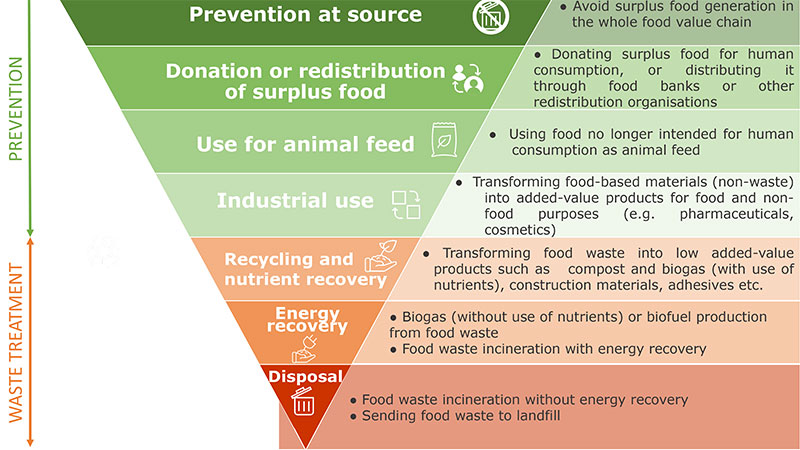
Source: Building evidence on food waste prevention interventions
European Commission Joint Research Centre, 2024
In this hierarchy, dairy cows and dike sheep—functioning as “recyclers”—rank above biogas plants (recoverers) and should not be overlooked when designing sustainable food systems. Their methane emissions must be considered alongside the ecosystem services they provide. Simultaneously, the use of concentrated feed derived from critical resources with high hef-values, elevated CO2-equivalents, and negative biodiversity impacts should be minimised. Feed concentrates could primarily serve health-critical periods, such as calving, peak production phases or sickness.
Currently, European livestock diets, according to the European Feed Manufacturers’ Federation (FEFAC), consist of approximately:
-
- 61% green fodder (hef = 0),
-
- 16% on-farm feed (hef undefined),
-
- 23% compound feed.
The compound feed itself is composed of around 30–44% by-products from food production, 50% cereals, and 1% domestic legumes (data from FEFAC, DVT & BLE). Yet, as long as arable land is still dedicated exclusively to feed cultivation, it remains the responsibility of animal nutritionists to innovate further strategies for circularity. Such advancements can ensure optimal utilisation of residual streams while addressing sustainability and food security challenges head-on.
Current Status: Achievements in Animal Nutrition Supporting the Circular Economy
Since the mid-20th century, remarkable advancements in feeding strategies and innovations have been developed and implemented in animal nutrition. These achievements highlight the significant strides made toward integrating circular economy principles:
Enhanced Efficiency through Breeding and Nutrition
Through the integration of selective breeding and precise nutrition, the feed input per kilogram of animal product has seen significant reductions:
-
- Cattle: Efficiency gains of 15–30%
-
- Pigs: 30–40%
-
- Poultry: 45–60%
These improvements have been realised through carefully tailored phase feeding and nutrient-specific rations. In recent years, innovations such as drinking water additives and boluses (specially designed tablets providing essential nutrients or medications over extended periods) have further optimised efficiency.
EU-Wide Approval of By-Products as Feedingstuffs
The adoption of EU Regulation 68/2013 has enabled the widespread use of by-products from food production as single feedingstuffs. Approved materials include:
-
- By-products from fruit and vegetable processing
-
- Dairy products and derivatives
-
- Slaughter by-products from land animals
-
- Fishmeal derived from by-catch and aquatic by-products
-
- Residues from the baking, confectionery, and cereal industries
-
- Products from spice, seasoning, and sauce production
-
- And many more. expanding feed diversity while reducing waste in food production
In particular, by-products from fruit and vegetable processing as well as herbs and spices can help to reduce the need for medication in animal production. Many of these herbal substances, which have long proven effective in traditional herbal medicine, are now deliberately used to support animal health in a natural way.
Biotechnological Breakthroughs: Enzymes
Enzymes such as phytases, xylanases, and proteases have revolutionised feed utilisation. These biotechnological tools improve the digestibility of co-products and by-products:
-
- Xylanases and ß-glucanases enhance the breakdown of non-starch polysaccharides, increasing available energy and nutrient accessibility
-
- Phytases unlock plant-bound phosphorus, reducing reliance on finite inorganic phosphorus resources (Rosenfelder-Kuon et al., 2019)
-
- Proteases improve protein absorption by converting proteins into amino acids, maximising feed efficiency
Synthetic Amino Acids
Every protein consists of amino acids and has its own pattern. The use of synthetic amino acids allows precise tailoring of dietary protein content. This reduces the overall protein requirement without compromising animal performance. This feeding strategy contributes to:
-
- Lowered emissions from animal production
Insect Proteins
Approved for aquaculture since 2017 and for poultry and pigs in 2021, insect proteins offer a sustainable alternative to traditional protein sources like soy and fishmeal. Insect-based feeds provide high protein content with favourable amino acid profiles. However, challenges remain, including high production costs, limited capacity, strict EU regulations, and consumer acceptance. Importantly, insects are classified as livestock within the EU, which prohibits feeding them with food waste – only feed-grade substrates are allowed
Currently, innovative start-ups are developing on-farm solutions for insect production. When these insects are fed with farm-generated by-products and – ideally – offered live to pigs or poultry, a truly circular system is established. An additional benefit: animal welfare is enhanced, as live insects reflect the natural diet of both species and provide valuable cognitive stimulation.
Necessities: Facing Waste, Embracing Innovation
The Food Waste Challenge
Within the EU, tackling food waste must become a priority. Each year, private households generate over 59 million tonnes of food waste – an average of 132 kg per person, equating to a market value of around €132 billion.
As a first countermeasure, reducing overconsumption through government-led consumer education would be highly desirable – for example, through schools, public broadcasters and campaigns in communal spaces. The EU has committed to achieving Target 12.3 of the Sustainable Development Goals: halving per capita food waste at the retail and consumer levels by 2030.
Such waste could become a valuable input in livestock nutrition, provided it were possible to eliminate pathogens (notably Bovine Spongiform Encephalopathy, African Swine Fever, Foot-and-Mouth Disease and Avian Influenza) and contaminants such as heavy metals, microplastics, and PFAS.
At present, Wageningen University & Research is investigating to what extent insects like the black soldier fly and the mealworm could safely process such waste. Initial results indicate an extremely low risk of prion transmission to pigs or poultry. However, the studies also identify significant limitations with household waste, whereas commercial food waste is deemed safe for insect feed.
Technologies such as precision fermentation open further possibilities: they enable the production of high-purity, tailor-made feed components from waste-derived raw materials. This method bypasses direct biological risks by creating new, defined end-products. However, such products fall under the category of “novel feed materials”, requiring a full safety assessment, regardless of the safety of the underlying processes.
Other technologies under discussion include supercritical water gasification and pyrolysis, mainly aimed at energy recovery from food waste. Some outputs – such as biochar from pyrolysis – show promise as functional feed additives, improving toxin-binding capacity and animal health, thus indirectly contributing to circularity.
Innovation needs Regulatory Efficiency
Still, regulatory hurdles remain a bottleneck. Although they safeguard food and feed safety in the EU, current frameworks are widely viewed as over-regulated, creating barriers for innovation. In response, leading agricultural and food industry stakeholders have jointly called for reform, demanding:
-
- A revision of the EU regulatory framework, particularly the Transparency Regulation, to reduce administrative burdens, foster innovation, and make the EU more attractive for investment;
-
- Streamlined risk and guidance assessments, including more transparent stakeholder involvement, improved applicant interaction and practical expertise within EFSA panels;
-
- A stronger push for novel assessment approaches, including essential, consistent data requirements and prioritisation of non-animal testing methods (NAMs) in the evaluation process.
Where to start in practice?
In practical animal nutrition, the hef-value can already be applied to optimise rations, ensuring minimal feed competition and enabling labels such as: “This litre of milk was produced without human-edible feed input.”
Similarly, regionally sourced or on-farm feed – if carefully formulated to meet nutrient needs – can help qualify products for a low-CO₂ label. In addition to their climate benefits, regional value chains promote independence from volatile global markets and internalise environmental externalities like biodiversity loss from intensive feed crop cultivation.
As transparency expectations grow, especially among consumers, indicators such as hef, CO₂ reduction potential, and ecosystem service contributions are likely to become powerful selling points for animal-derived products.
Conclusion: Closing Loops Together – with Innovative Livestock Farming
Livestock farming holds the potential to become a cornerstone of a real circular food system—one that respects planetary boundaries while enhancing global food security. By harnessing residual streams, optimising feed formulations through the hef-value, and leveraging cutting-edge technologies such as precision fermentation and insect protein, we can raise efficiency and significantly reduce environmental impacts.
Some may argue that innovation will inevitably raise the price of animal products. But hasn’t every breakthrough been costly before becoming mainstream?
And secondly— Are food prices truly too high—or have we lost perspective in the plenty? We’ll take a closer look at this in our next blog.
All we have is now. Let’s advance tangible, future-ready solutions that support sustainable animal agriculture and build resilient, regenerative food systems.
At The Feed Rethinkery, we invite you to be part of this transformation—through innovation, collaboration, and the shared exchange of knowledge. Follow us, join the dialogue, and help shape the circular economy of tomorrow—from farm to table, and beyond.
Planning a feed innovation?
The Feed Rethinkery supports you at every stage of the process – with scientific rigour, practical relevance and efficiency.
🔹 We create technical dossiers that align your entire project team – ensuring clarity, shared knowledge and informed decision-making.
🔹 We design your trials with maximum efficiency – saving both animals and valuable R&D budget.
🔹 We handle study applications and communication with regulatory authorities – professionally and on equal footing.
🔹 We analyse your data and turn results into reusable knowledge – ensuring long-term value for your organisation.
🔹 And we help communicate your findings – whether for marketing, regulatory submissions or peer-reviewed publications.
Let’s bring innovation full circle – together.
